 Spinal FrontiersPowered by NSpine
How it works
- This month: the case. The guest editor's case with the clinical description, the key images and the question, such as the next step, the levels to include or the likely complication.
- Your comments. Send your answer or comment to spinalfrontiers@nspine.com. The Spinal Frontiers team forwards every comment to the guest editor.
- A week later: the answer. The guest editor's treatment strategy and outcome, with a short summary of readers' comments.
Comments may be quoted with the answer. We publish your name only if you tell us we may.
This month’s case: a progressive curve in a child who lives curled up
November 2026 · presented by the guest editor, Dr. med. habil. Bronek Boszczyk
Week 1: the case. The guest editor’s solution follows next week.
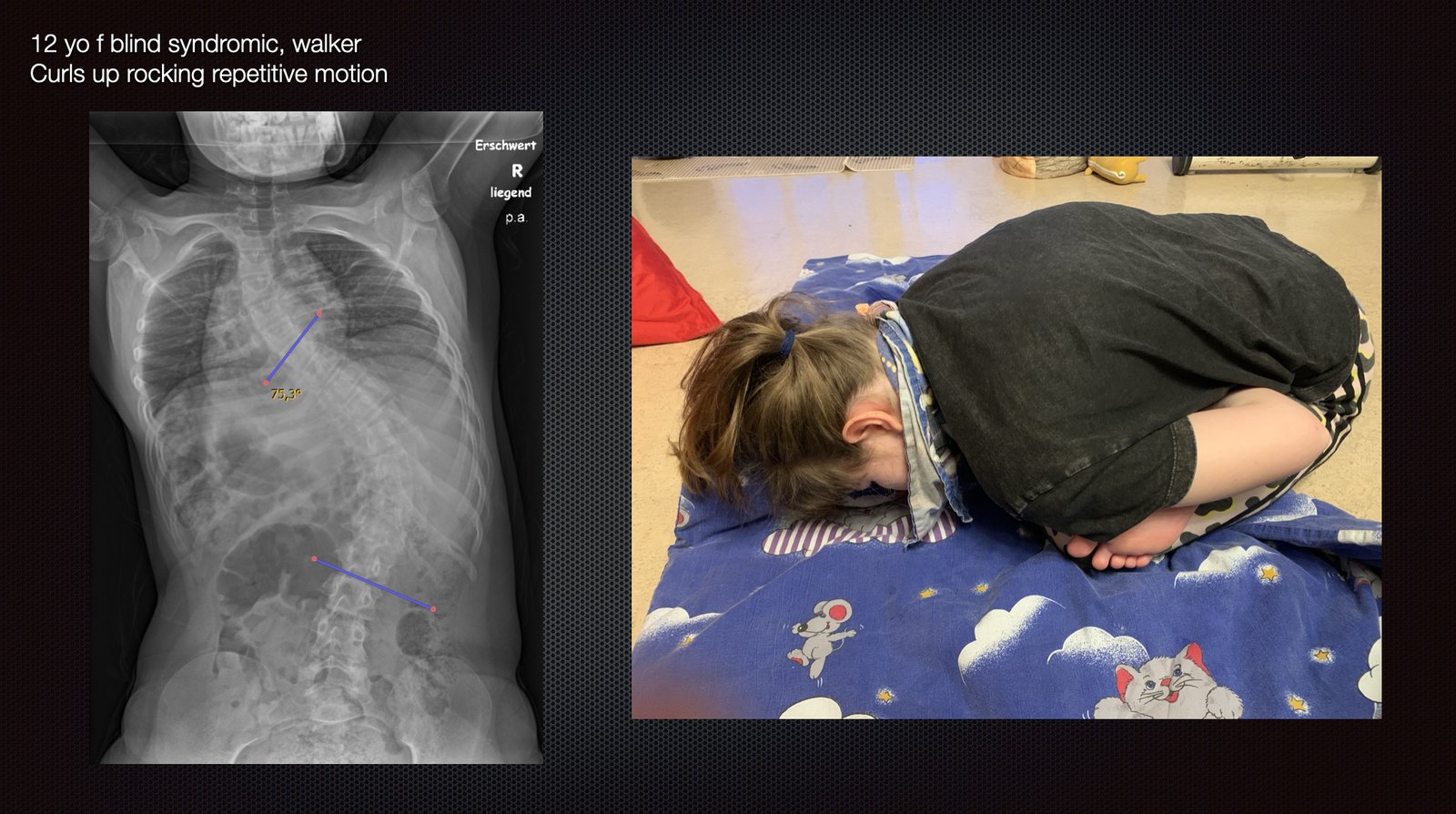
The patient
A 12-year-old girl, blind, with a syndromic condition. She can walk short distances when guided. She spends much of her day curled up in flexion, which is her comfort position, with repetitive rocking and flexing movements.
She has a progressive structural thoracolumbar curve, 75° on a supine film, which has not responded to conservative treatment. She does not cooperate with physiotherapy and does not tolerate a brace.
The dilemma
A progressive structural curve in a 12-year-old, in a patient who cannot cooperate with treatment and whose constant flexion and repetitive movements are her source of comfort.
Your view
How would you manage her? Would you operate, and if so when, and with which strategy? How do her constant flexion and rocking change your choice of levels, implants and aftercare, and how would you protect her ability to walk?
Send your answer or comment to spinalfrontiers@nspine.com. We forward every comment to the guest editor, and may quote comments next week (your name only if you say we may). Please do not include patient details.
Patient privacy and consent
Identifying details are removed from every case before publication, including details hidden in image files, and a case is published only with the patient's (or a parent's or guardian's) consent to publication, in line with the guest editor's hospital policy. Case images appear only on this website; we never post them on social media. Please do not include patient details in your comments.
Teaching, not advice
Cases are for education and discussion among professionals. They are not treatment recommendations for individual patients.