 Spinal FrontiersPowered by NSpine
Introduction
It's a pleasure to write the first guest editorial of Spinal Frontiers, a uniquely broad resource for everyone in spinal care. I look forward to watching it grow through contributions from the whole spine community.
It is truly multidisciplinary, serving spine surgeons, allied health professionals, anaesthetists, pain physicians and even veterinary spine surgeons. It is also a resource for medtech professionals, whose contribution to spine care is greatly valued.
Researchers will find the latest publications, patents and trials, along with funding calls, registries and abstract deadlines. Those developing spine services will find a directory of spine medtech companies, instructions for use and technique guides, and even a spine theatre builder. Jobs, fellowships and a worldwide calendar of meetings round off the picture, for established clinicians and trainees alike.
— Dr. med. habil. Bronek Boszczyk, guest editor, November 2026
About me
I was born and raised in Johannesburg, to a South African mother and a German father, and South Africa still feels like home. After school at the Deutsche Schule Johannesburg I moved to Germany and served with the mountain infantry, the Gebirgsjäger, which left me with a lasting love of the Bavarian Alps.
My interest in the spine began at the University of Munich, with my doctoral thesis under Professor Putz comparing the lumbar spine across mammals. During my rotation in paediatric orthopaedics, Michael Mayer started his spine unit in Munich, and I joined him as one of his first residents. His new spine service combined neurosurgery and orthopaedics, microsurgery and reconstruction. He encouraged me to train in neurosurgery, which I completed under Professor Jaksche, followed by time in the spinal cord injuries unit. In spinal trauma I worked closely with Drs Beisse, Potulski and Hauck, who at the time were world leaders in thoracoscopic spine surgery.
I then returned to orthopaedics with a fellowship under Professor Paul Heini in Bern, the centre shaped by Max Aebi and Dante Marchesi, where I was introduced to paediatric deformity surgery. After two years I moved to the Centre for Spinal Studies and Surgery in Nottingham, founded by John Webb, which serves close to five million people. I stayed as a consultant for 13 years, five of them as the first neurosurgeon to head the unit.
In Nottingham I founded NSpine with my friend Sherif El Sayed, then a fellow there, as a conference giving practical teaching to the working surgeon; the N stands for Nottingham. It soon outgrew its home and became an international provider of surgical training. I am also establishing the Blackwell Foundation, a non-profit for outreach, mentorship and independent international fellowships.
After Brexit I returned to Germany and founded a paediatric spinal deformity department at one of the country's oldest paediatric orthopaedic hospitals, in Aschau, where Dr Areena D'Souza, a Nottingham fellowship-trained deformity surgeon, joined me. Together we run a paediatric spine service for regional and supra-regional referrals.
I have no formal training in business, law or tax, so building NSpine has meant learning by doing. Away from work I play bass guitar, for many years with the Sultans of Spine, and I founded the charity band Angel206, named after the 206 bones of the body, which raises funds for projects including paediatric spinal deformity care.
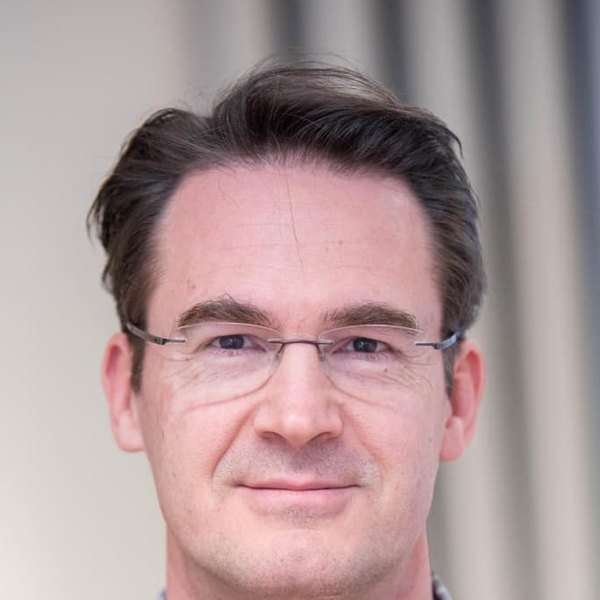
The photo is from the end of my time in Nottingham, when my surgical practice was at its broadest.
My picks of the month
Patent: an automated robotic rod bender (Globus Medical, US 12,715,142 B2, granted 25 August 2026)
A two-arm robot: one arm feeds and rotates the rod while the other bends it to a patient-specific contour.
This patent caught my eye because it marks a new phase in theatre: robots taking over tasks we have always done by hand. I can already picture a humanoid robot bending rods beside the scrub team, an intriguing glimpse of things to come.
Declared interest: NSpine's courses receive support from medical device companies, including Globus Medical. Spinal Frontiers receives no payment for coverage.
See it in Patent Watch → · Humanoid robots in theatre: our monthly watch →
Historic book: Nicolas Andry, Orthopaedia (1743)
My second pick is one I came across while reviewing this issue: Nicolas Andry's Orthopaedia of 1743, free to read in our new Classics section. Andry gave orthopaedics its name and its emblem, the crooked young tree bound to a straight stake. For anyone who treats spinal deformity in children, it's still the perfect picture of what we do, even if the likeness was drawn to correct deformity in a child's leg.
Read it free in Classics and historic books →
Five Minutes of Wisdom
Remember the legacy that built you. Remember those who took the time to train you as a young surgeon and shared their knowledge and wisdom. As you join the older surgical generation, there is great joy in seeing those you trained become the new leaders of our specialty. The debt you owe your trainers is repaid to your trainees. This is the essence of surgical training, and what keeps the cycle of our profession turning.
The easiest thing for a surgeon is to keep the case. Do every step yourself, explain a little as you go, and no one is put at risk. But that isn't training. Training means letting a trainee take ownership of a case, step by step, and for us that means letting go. We hand over part of the responsibility, and part of the danger.
We carry a dual duty. We must protect our patients and make sure they receive the best care. And we must protect our trainees, from the consequences of causing harm, and from leaving training without the skill and confidence to carry our specialty forward.
What makes this possible is trust, and trust runs both ways. I can only step away from the table if I know, without any doubt, that my trainee will stop when something isn't right, and call me. So I need to know them as a person: their sense of responsibility, what makes them afraid, what gives them courage.
A word of consideration for trainees, then. Tell us honestly what you are comfortable doing, and where you are unsure. Saying 'I need guidance here' is not weakness. It is exactly what lets us trust you with more. Knowing when to stop is the most important skill we can see in you.
The debt we owe our trainers is repaid to our trainees, and trust is the currency we pay it in.
— Dr. med. habil. Bronek Boszczyk, guest editor, November 2026
The guest editor's recipe: Bronek's High-Protein Quick Fix
Breakfast · about 10 minutes · serves one
My go-to breakfast before a long day in theatre. The fun is in the contrast: hot scrambled eggs next to cold tuna.
You need
- 1 ripe avocado
- 1 tin of tuna in olive oil, from the fridge (or tuna in water with a splash of olive oil)
- 2 eggs
- Black pepper, salt flakes and Tabasco
Method
- Halve the avocado and remove the stone. Season with pepper, salt flakes and Tabasco, and eat it straight from the skin with a spoon.
- Season the cold tuna with black pepper.
- Scramble the eggs with pepper, salt and a dash of Tabasco (add anything else you like), and serve them hot next to the cold tuna.
| Approximate values | Protein | Energy |
|---|---|---|
| Tin of tuna in oil (about 120 g drained) | about 30 g | about 230 kcal |
| 2 eggs | about 13 g | about 150 kcal |
| 1 medium avocado | about 3 g | about 240 kcal (and about 10 g fibre) |
| Total | about 45 g | about 620 kcal |
Approximate, based on typical values; brands and sizes vary. Contains fish and egg.
For me, at 90 kg on a busy day, that covers roughly 40 to 50% of my daily protein needs.
More quick meals are on Health & Nutrition.
60 Seconds of Wisdom
From Bronek Boszczyk: some 30 years in spine surgery, and 20 years running training courses and conferences.
Five minutes to read, sixty seconds to watch. Each month the guest editor records a one-minute video, shared here and on the Spinal Frontiers social channels. The video is hosted on this site and loads only when you press play.
November 2026 · 63 seconds
Case of the Month
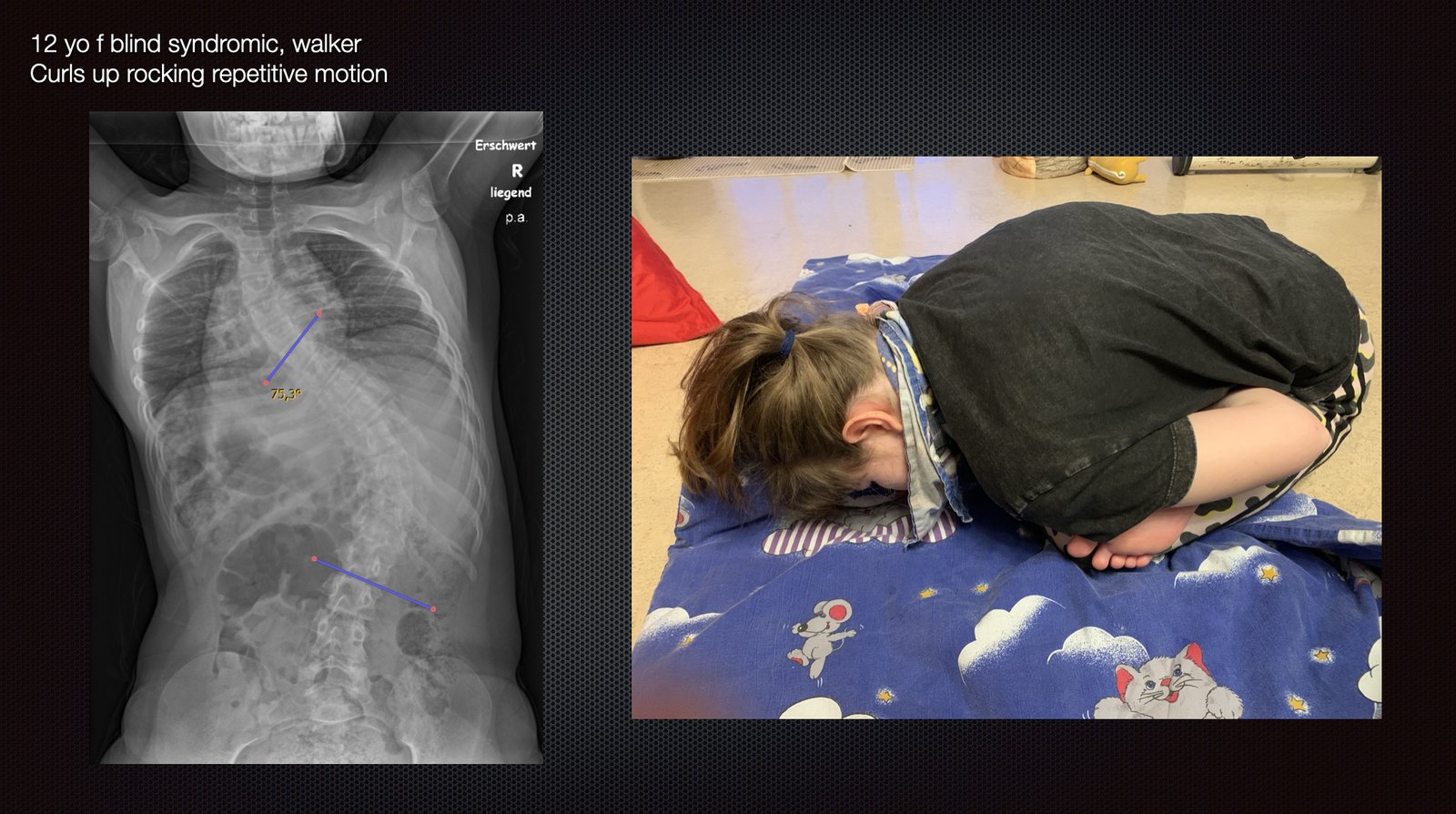
A progressive curve in a child who lives curled up. A blind 12-year-old girl with a syndromic condition, able to walk short distances when guided, has a progressive structural thoracolumbar curve of 75° (supine). Physiotherapy and bracing have failed, and she spends much of her day curled up in flexion, her comfort position, with repetitive rocking. How would you manage her?
See the case and send your view → My solution follows next week.
Conflicts of interest
NSpine Limited, which I founded and direct, publishes Spinal Frontiers. NSpine's courses receive support from medical device companies, including Globus Medical. I also chair the Blackwell Foundation in Switzerland, which supports surgical education. I invest in medtech companies from time to time, and currently hold no shares in spine medtech companies. And as bassist of Angel206, I may be biased in thinking our songs are among the best out there.
For future clinical guest editors
If you would like to be a clinical guest editor, please contact us first at spinalfrontiers@nspine.com. We plan the issues in advance and will agree a month with you.
If you are given an issue, we will ask you to send, four weeks before it appears: a free introduction (up to 250 words) · About me (up to 400 words) · one or two picks of the month from anywhere on the site (a paper, patent, guideline, device, meeting or resource), each with a few lines on why · Five Minutes of Wisdom (up to 300 words), on one of: How I Run My Practice, Lessons from My Unit, Three Things I'd Tell My Younger Self, or Behind the Scenes · a 60-second phone video, filmed upright, for 60 Seconds of Wisdom · a favourite recipe of 30 minutes or less · one case with consent and anonymisation confirmed · your conflicts of interest, including shareholdings in any company whose product you pick · a portrait photo (head and shoulders, at least 800 × 800 pixels, plain background). The editors may shorten text and will send the final version for approval. Guest editors are not paid and have no say over other sections.
Research guest editor: volunteer
Each month a research guest editor (a clinical academic, spine scientist or methodologist) chooses up to ten papers from that month's Literature Watch for readers to read first. Fewer than ten is fine.
What it involves: about two hours a month. We send you a shortlist of around thirty papers with draft evidence grades by the 5th of the month. You choose your picks, confirm or change each grade using our evidence key, and add one or two sentences on why each paper matters, by the 10th. You are named on the page with your post and institution.
The rules: you do not pick your own papers or your co-authors' papers, and you declare your conflicts of interest, which we publish beside your picks.
Volunteer as research guest editor
Or email spinalfrontiers@nspine.com with your name, post, research area and conflicts of interest.